
Theory of Change

How we believe lasting change happens

Our theory of change reflects decades of learning about what enables - and what undermines - sustainable systemic transformation. It continues to evolve as we learn.

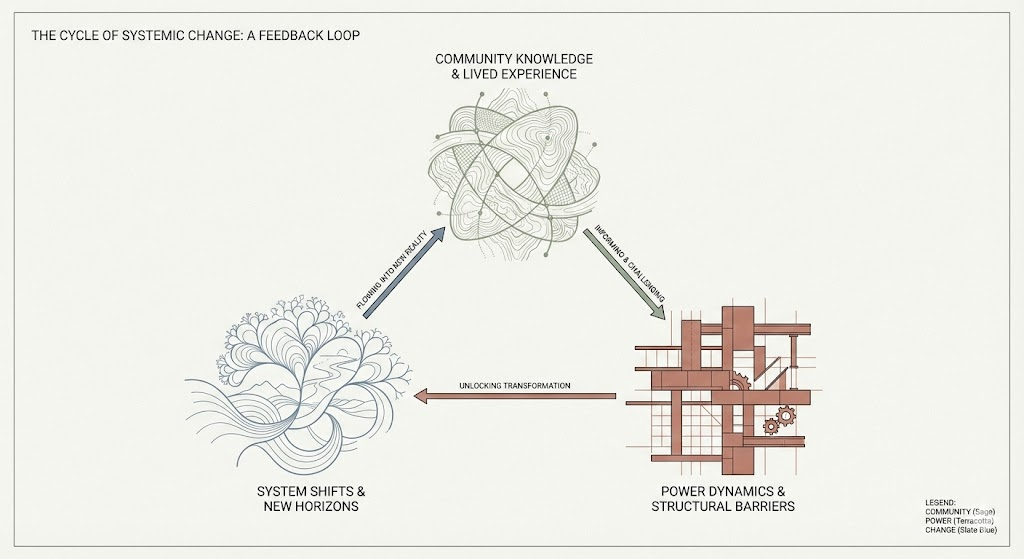
Cycle of Systemic Change: Community Knowledge flows into Power Dynamics, unlocking System Shifts

The Cycle of Systemic Change: A continuous feedback loop.

The Logic of Change

Complex social challenges - housing, health equity, climate adaptation, democratic participation - resist simple solutions because they're embedded in systems. These systems have evolved over time, shaped by policy, markets, culture, and power dynamics.

Many effective approaches already exist, but they are fragmented across silos of practice, policy, capital, and lived experience. We help translate across these silos and build connective infrastructure so learning travels and coordinated action becomes possible.

Our Theory in Brief:

IF we strengthen community agency to understand and influence the systems shaping their lives, AND we build shared infrastructure for collaboration, learning, and investment across sectors and regions,

THEN more resilient, equitable, and adaptive systems can emerge that improve well-being for people and planet.

We believe sustainable change requires a different approach - one that combines rigorous understanding of systems with genuine partnership with communities.

What we count on

  • Trust is the speed of change. Technical solutions move at the speed of code; social change moves at the speed of trust. We assume that investing in relationships is investing in the primary infrastructure of change.
  • Latent capacity exists. We assume that communities already possess the wisdom and capability to solve their own problems, but are often blocked by structural barriers or lack of resources.
  • Policy windows open and close. Systems tend towards stability but face moments of disruption. We assume communities hold deep wisdom and capability, but are often constrained by power imbalances, policy barriers, and uneven access to resources.
  • Process shapes outcomes. How change happens influences whether it lasts. Extractive, top-down processes undermine sustainability even when they achieve short-term wins.
  • Learning must be continuous. Complex systems are dynamic. Effective intervention requires ongoing learning and adaptation, not rigid adherence to predetermined plans.

What we bring to this work

We work at the intersection of analysis and action, helping partners see their challenges more clearly while building capacity to respond. Our contribution includes:

  • Systems perspective. Frameworks and tools that help partners understand how challenges are embedded in larger dynamics.
  • Participatory practice. Methods for engaging communities as partners in understanding and addressing challenges.
  • Convening capacity. Skills and relationships that enable diverse actors to collaborate effectively.
  • Learning orientation. Approaches to evaluation and reflection that generate actionable insight rather than just accountability metrics.
  • Knowledge mobilization. Turning fragmented insights into shared sensemaking, tools, and practice so learning moves lab-to-land.
  • Systemic investing infrastructure. Helping align capital structures with resilience, equity, and non-monetary returns, not only short-term outputs.

"The goal is not to predict the future, but to make it possible for communities to shape it."

Leaning into discomfort

Systemic change work requires living with tensions that cannot be fully resolved. Rather than seeking simple answers, we intentionally hold space for the productive discomfort that emerges when important values pull in different directions.

These are not problems to solve but edges to navigate. They represent trade-offs we actively manage, staying attentive to when we're leaning too far in one direction:

  • Speed vs. Legitimacy. Moving quickly enough to matter while taking time to build genuine consent and ownership. Urgency is real, but shortcuts on participation often undermine the outcomes we seek.
  • Measurement vs. Meaning. Being accountable and learning from evidence while not reducing complex human outcomes to what can be easily counted. Numbers can illuminate or obscure.
  • Openness vs. Sovereignty. Sharing knowledge and resources while respecting that communities and Indigenous partners and rightsholders have the right to govern their own data, stories, and intellectual property.
  • Innovation vs. Institutional Safety. Creating space for experimentation and failure while operating within organizations and systems that often reward predictability and risk aversion.

We believe the ability to hold these tensions, rather than collapse them, is itself a form of capacity that enables more nuanced and effective action.

Shifting from Reach to Resilience

We measure our work not by the number of people reached, but by the depth of capacity built and the resilience of the systems we influence.

  • Enhanced community agency. Communities better equipped to understand, navigate, and influence the systems that affect them.
  • Improved institutional practice. Foundations, governments, and other institutions working in ways that are more responsive, humble, and effective.
  • Stronger networks. Relationships and forums that enable ongoing collaboration across sectors and perspectives.
  • System-level shifts. Changes in policies, norms, resources and capital flows, and power dynamics that create more equitable and sustainable outcomes.

The goal is not to predict the future, but to build the conditions where communities can shape it on their own terms

We're always interested in conversations with others working toward systemic change, whether to explore potential partnership or simply to learn from each other.

Get in Touch